

The housing types available in Doylestown date back to the 1800s, and this is also the main challenge you face when trying to buy a smart switch here. What you can use comes down to what is inside your wall box and not which brand you can trust the most. The guide shows you which brand to look for locally, and what tests you should perform before spending money on a smart switch, where you can get a fair price, and what permits you may have to get when switching it over.
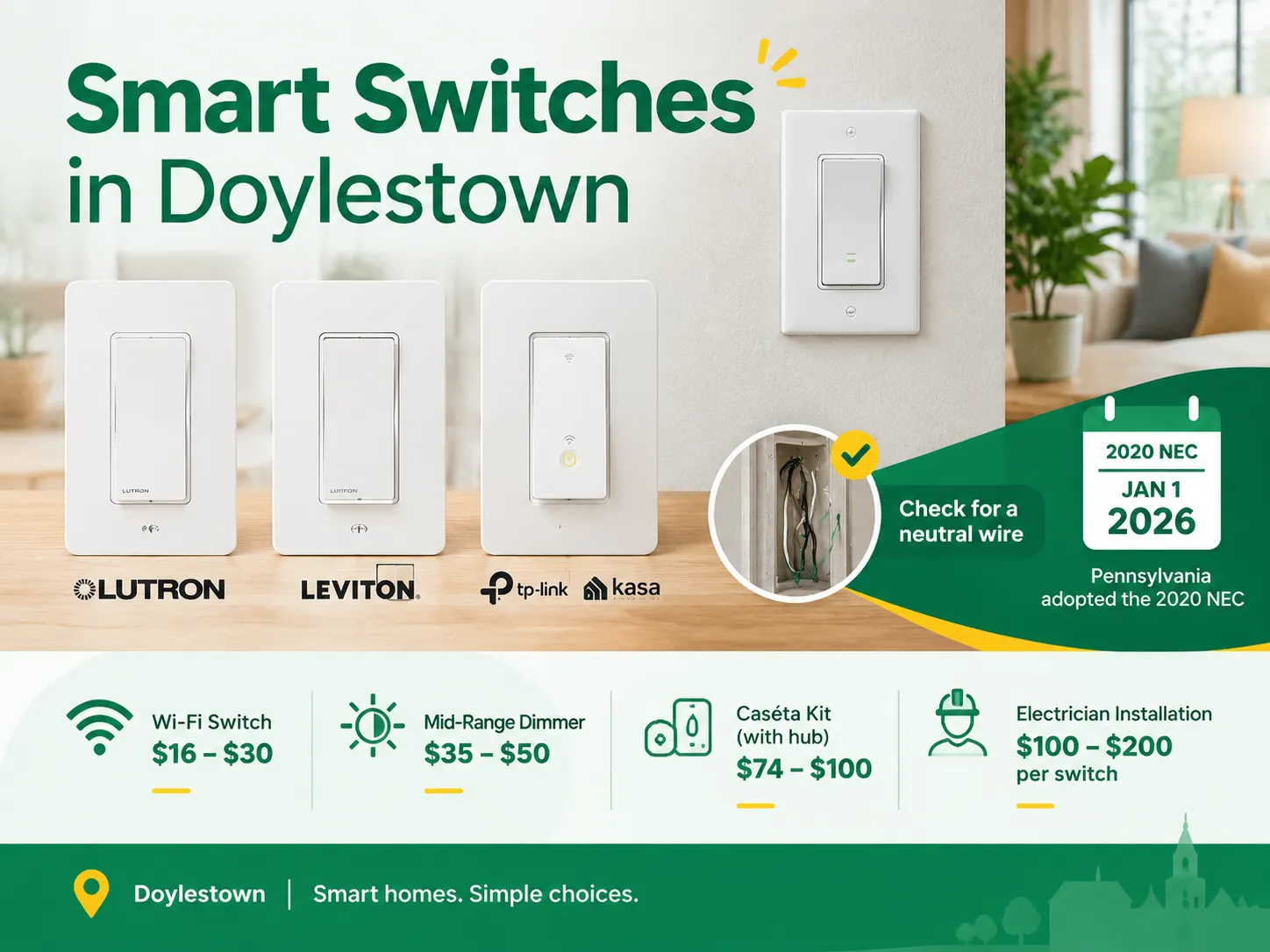
Quick Answer: In terms of smart switches for your house in Doylestown, the most popular choices include Lutron Caséta (which is the local option because the company has its headquarters in Coopersburg, Pennsylvania), Leviton Decora Smart (the Apple HomeKit and Matter smart switch option) and the relatively inexpensive TP-Link Kasa or Tapo brands for switching via Wi-Fi. The prices for a simple smart Wi-Fi switch are expected to range from $16 to $30, while a smart dimmer will cost $35 to $50 on average. A Caséta smart switch kit together with its hub will cost about $74 to $100. However, before making a purchase, ensure that there is a neutral wire in your house, since most smart switches require neutral wires, and houses older than 1985 are likely not equipped with one. A licensed electrician will charge you around $100 to $200 per single installation of a smart switch in Doylestown. The state of Pennsylvania is to switch to the National Electrical Code of 2020 starting from January 1, 2026.
A smart switch is a replacement for the switch on the wall itself, which makes all the difference and the reason why smart switches work while smart bulbs fail.
A smart bulb is a bulb with a radio and controller built into it. It performs well until someone switches off the switch on the wall, since it goes without power.
In a house in Doylestown, that means a smart switch needs to be installed in two circumstances: where a room has multiple bulbs on one circuit and changing all lamps would be more costly than changing the switch; and rooms containing ceiling fixtures or fans which need to be controlled without replacing the whole fixture.The underlying shift — from a mechanical contact to a semiconductor plus a radio — and what it changes about reliability, dimming and load compatibility is the subject of its own explanation of the essence of smart switches, which is worth reading before you assume a smart bulb would do the same job.
Four local realities define your purchasing capabilities.
The age of wiring varies considerably. Doylestown Borough has homes built in the 1700s and 1800s, and the majority of mid-century homes built in the surrounding townships were constructed before the installation of a neutral at the switch box. The homes built about 1985 have a neutral in the switch box almost without exception. In between these two dates, however, it is a fifty-fifty chance that the house has a neutral in the switch box. The biggest reason for a return of the smart switch is incompatibility with wiring.
After 1 January 2026 regulations for electrical work have changed in Pennsylvania. Pennsylvania Uniform Construction Code followed the 2021 International Codes and 2020 National Electrical Code from 01 January 2026 with a grace period until 30 June 2026 for contracts signed before that date. In regard to smart switch installation, it does not matter whether the job complies with the new code or not as far as its practicalities are concerned.
Licensing is done at the local level. Pennsylvania does not impose any electrical license at the state level. Licensing and permitting are done municipality by municipality, where more than 90% of the towns, or even larger towns, have their own regulatory authorities or hire a certified third-party agency. The meaning of this is that one needs to check with Doylestown Borough or the township rather than the state of Pennsylvania. Fees for electrical work range from $50 to $300.
No one contacts the utility in the case of switch replacement. It is important to know that PECO enters the picture only if the job is connected with the service equipment.
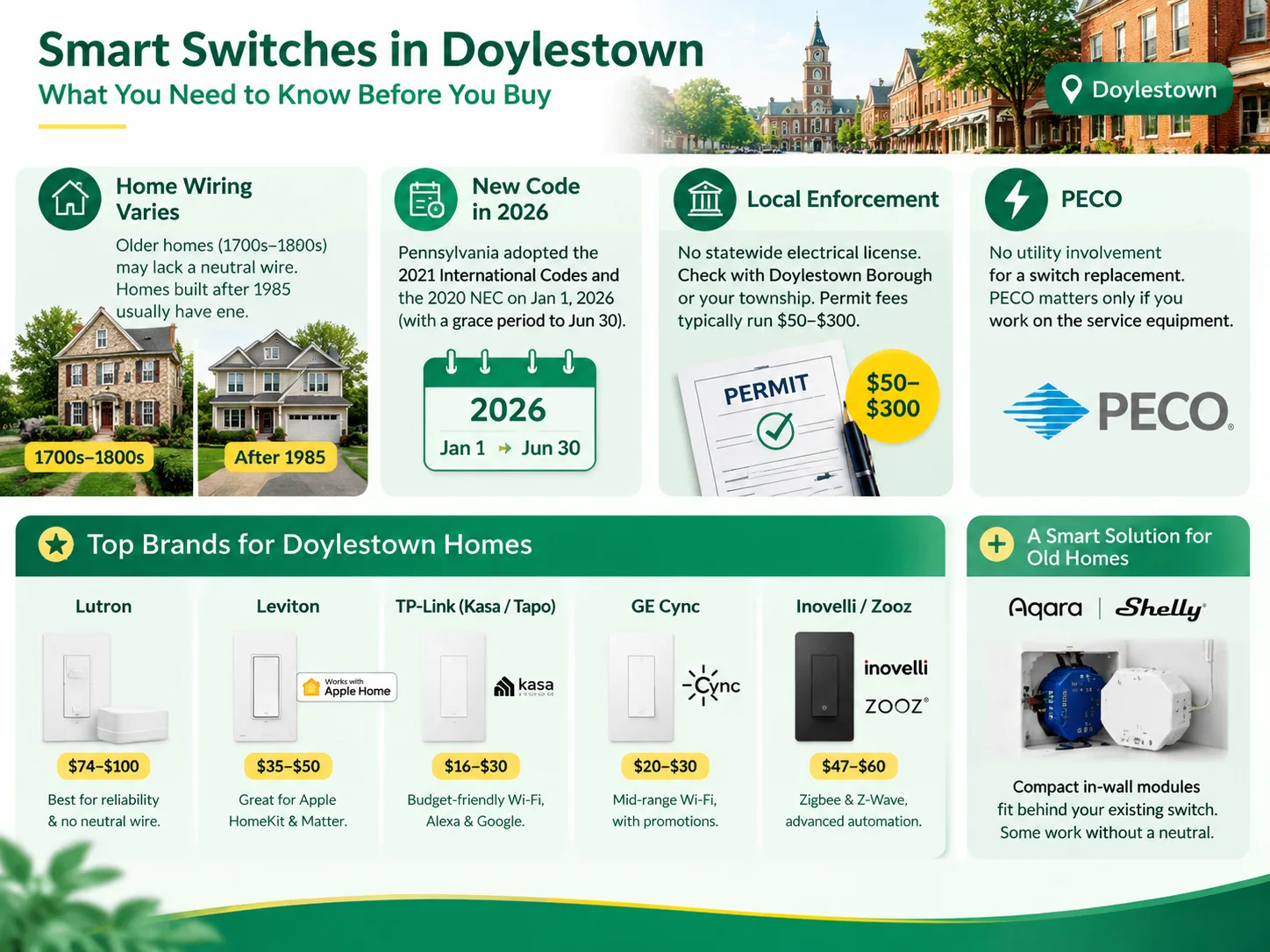
Five brands cover almost every residential case. Prices are typical US retail for 2026 and are per device unless noted.
| Brand | Home base | Signature product | Typical price | Best for |
|---|---|---|---|---|
| Lutron | Coopersburg, Pennsylvania | Caséta, Diva, Maestro, Sunnata | $74–$100 (kit with hub) | Reliability; homes with no neutral wire |
| Leviton | Melville, New York | Decora Smart D26HD, D315S | $35–$50 | Apple HomeKit and Matter |
| TP-Link (Kasa / Tapo) | China, US distribution | Kasa HS200, HS220, Tapo S505 | $16–$30 | Budget Wi-Fi, Alexa and Google, no hub |
| GE Cync | United States | Cync smart switch and dimmer | $20–$30 | Mid-range Wi-Fi with frequent promotions |
| Inovelli / Zooz | United States | Blue Series 2-1, ZEN77 800LR | $47–$60 | Zigbee and Z-Wave users, advanced automation |
There is a sixth category worth mentioning because it tackles the biggest problem of the old houses’ wiring directly. Both Aqara and Shelly produce small in-wall devices that need to be placed behind an existing switch, and some of them can work without a neutral wire. They are not smart switches in themselves but rather an extra element to an already-existing switch, so they are very useful in cases when the corresponding junction box is too shallow for a full-sized smart switch.
When it comes to brand selection, the first thing to consider is the level of support. A brand that can be found in almost all major retail chains is easier to replace, return, and obtain enough information about. A brand sold exclusively online might not be that expensive but could cause major problems when it comes to obtaining support in case of any issues with either the hub or the firmware.Leviton in particular is worth a closer look if you are already inside the Apple ecosystem, and the reasoning behind that judgement is set out in this assessment of whether Leviton is a good brand.
This is the only truly local advantage in the smart switch business, and this is not a marketing claim.
Lutron Electronics was founded in Coopersburg, Pennsylvania, in 1961 in the Lehigh Valley — which is located approximately one hour north of Doylestown — by Joel Spira and his wife Ruth. Joel Spira developed the first solid-state electronic dimmer as he figured it out in the fifties that a thyristor can be used to decrease light. The original devices are displayed at the National Museum of American History at the Smithsonian Institution. The corporate has over 2,700 international patents and sells more than 15,000 energy-efficient products worldwide, including 10 billion kW of power and about $1 billion in costs saved in the United States.
What it means in practice for a Bucks County homeowner is threefold. Nowadays, it is easy to get parts and replacements by asking local electrical distributors or the big-chain ones. The system is mature, not experimental, which is important for a device that will stay in the wall for fifteen years. The advantage of using Lutron is also important because Clear Connect RF, a special technology of the company works on a separate frequency, ensuring that there are no issues with the network.
The trade-offs associated with using Caséta are equally clear. Although it is possible to use the application and voice control function through the Smart Bridge hub, the owners need to buy a kit instead of a single switch. The ecosystem is proprietary, which means expansion of devices will remain within Lutron only. And, some models, in comparison with Wi-Fi dimmers, are rated for lower LED loads which may be important while managing large fixtures.
Removing the cover plate gives you access to the wires inside the box. Look for a bunch of white wires connected with a wire nut, separate from the wires that go to the switch.
While the cover plate is removed, you can count wires and define the switch type. One switch is single pole. Two switches controlling one light in case of the three-way circuit (when it is at the top and down the stairs) will require either a matched three-way smart switch or a smart switch plus a wireless companion device. Making a wrong purchase due to the absence of a neutral is one of the most frequent cases of returns.
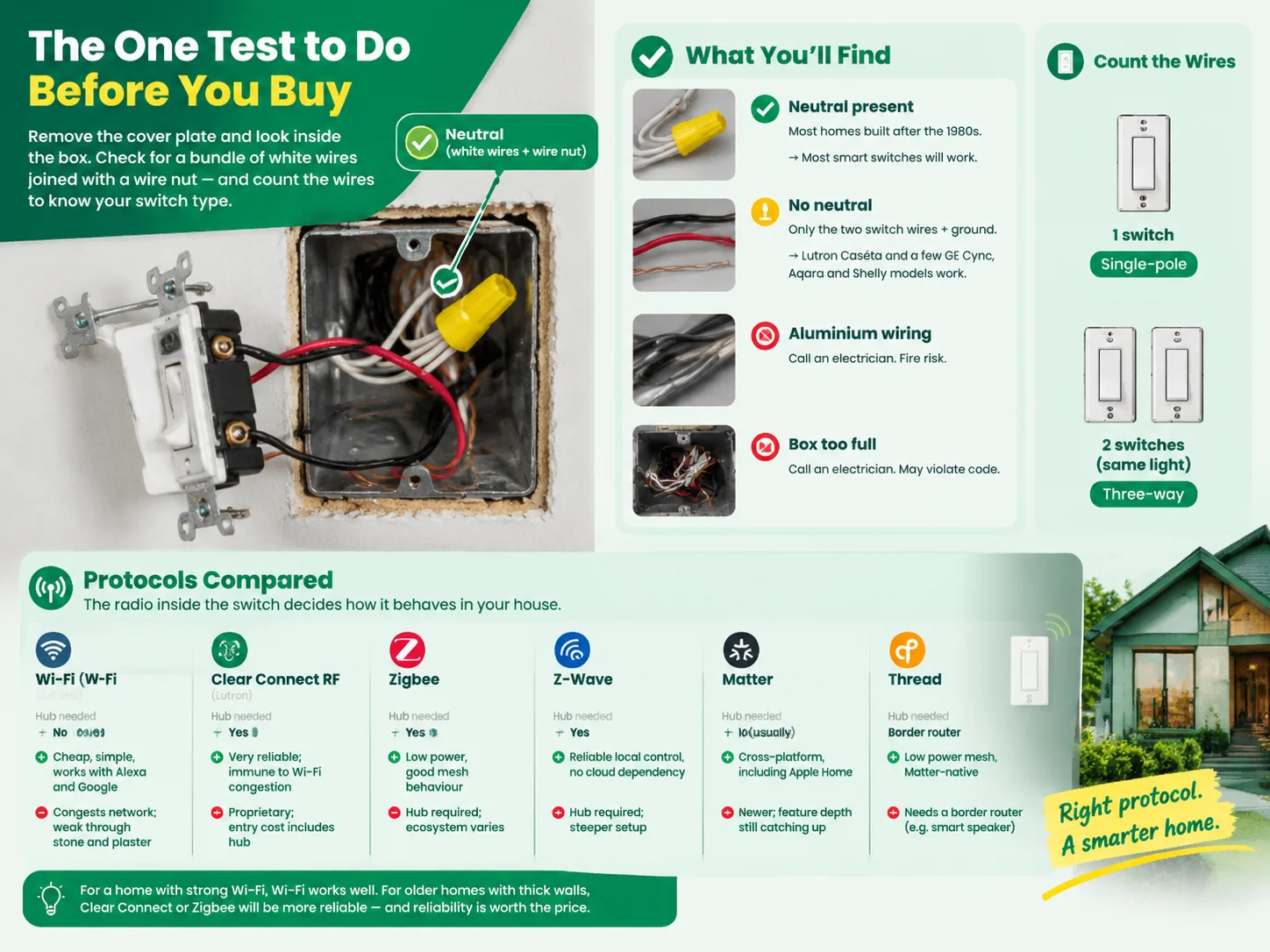
The radio inside the switch decides how it behaves in your house, and it matters more than the app.
| Protocol | Hub needed | Strength | Weakness |
|---|---|---|---|
| Wi-Fi (2.4 GHz) | No | Cheap, simple, works with Alexa and Google | Congests the network; weak through stone and plaster |
| Clear Connect RF (Lutron) | Yes | Immune to Wi-Fi congestion; very reliable | Proprietary; entry cost includes the hub |
| Zigbee | Yes | Low power, good mesh behaviour | Hub required; ecosystem varies |
| Z-Wave | Yes | Reliable local control, no cloud dependency | Hub required; steeper setup |
| Matter | No (usually) | Cross-platform, including Apple Home | Newer; feature depth still catching up |
| Thread | Border router | Low power mesh, Matter-native | Needs a border router such as a modern smart speaker |
In houses where the Wi-Fi signal has already spread well across all the rooms, it is cheaper to use wireless switches with a standard Wi-Fi switch. If the house is older with thick walls in Doylestown, however, a hub protocol with its own mesh is required, such as Clear Connect or Zigbee, since such a system is far more reliable in practice and this reliability is worth the difference in cost.
There are just six numbers and one listing to note.
Most dissatisfaction comes from the fourth point. A customer buys a dimmer and installs it, but the lights flicker due to the bulbs not being dimmable or the total load being below the minimum required by the dimmer. Both of these issues can be solved within 5 minutes while checking the packaging of the bulbs.
Three cost lines matter: the device, the labour, and the permit.
| Item | Typical range | Notes |
|---|---|---|
| Basic Wi-Fi smart switch (Kasa, Cync class) | $16–$30 | No hub; neutral usually required |
| Mid-range dimmer (Leviton Decora Smart class) | $35–$50 | HomeKit and Matter options |
| Lutron Caséta kit | $74–$100 | Includes hub and often a Pico remote |
| Wireless companion remote | $20–$40 | Creates a three-way function without new cable |
| Electrician labour, per switch | $100–$200 | Higher for three-way or no-neutral retrofits |
| Electrical permit | $50–$300 | Municipal; usually not required for a like-for-like swap |
There is a difference that makes it possible to calculate profit differently. Doing the first smart switch installation on one’s own takes from 20 to 30 minutes (this is your first time) and from 10 to 15 minutes afterward. So, DIY can be cost-effective for standard one-pole replacements. The service of the electrician is required in case of a three-way circuit installation, no-neutral upgrade, changes in the wiring, etc. The visit charge is approximately the same no matter how many switches you want to install, so the additional cost of installing four switches instead of just one is insignificant.
One more thing worth mentioning. Some insurers provide discounts for smart homes, which varies from one provider to another, and the cost of doing that is nothing.For a realistic picture of what lighting control actually costs once installers, hubs and programming are added up — figures that apply anywhere in the Philadelphia suburbs, not just in one town — this breakdown of smart lighting control systems, installers and real costs is a useful benchmark to hold against any quote you receive.
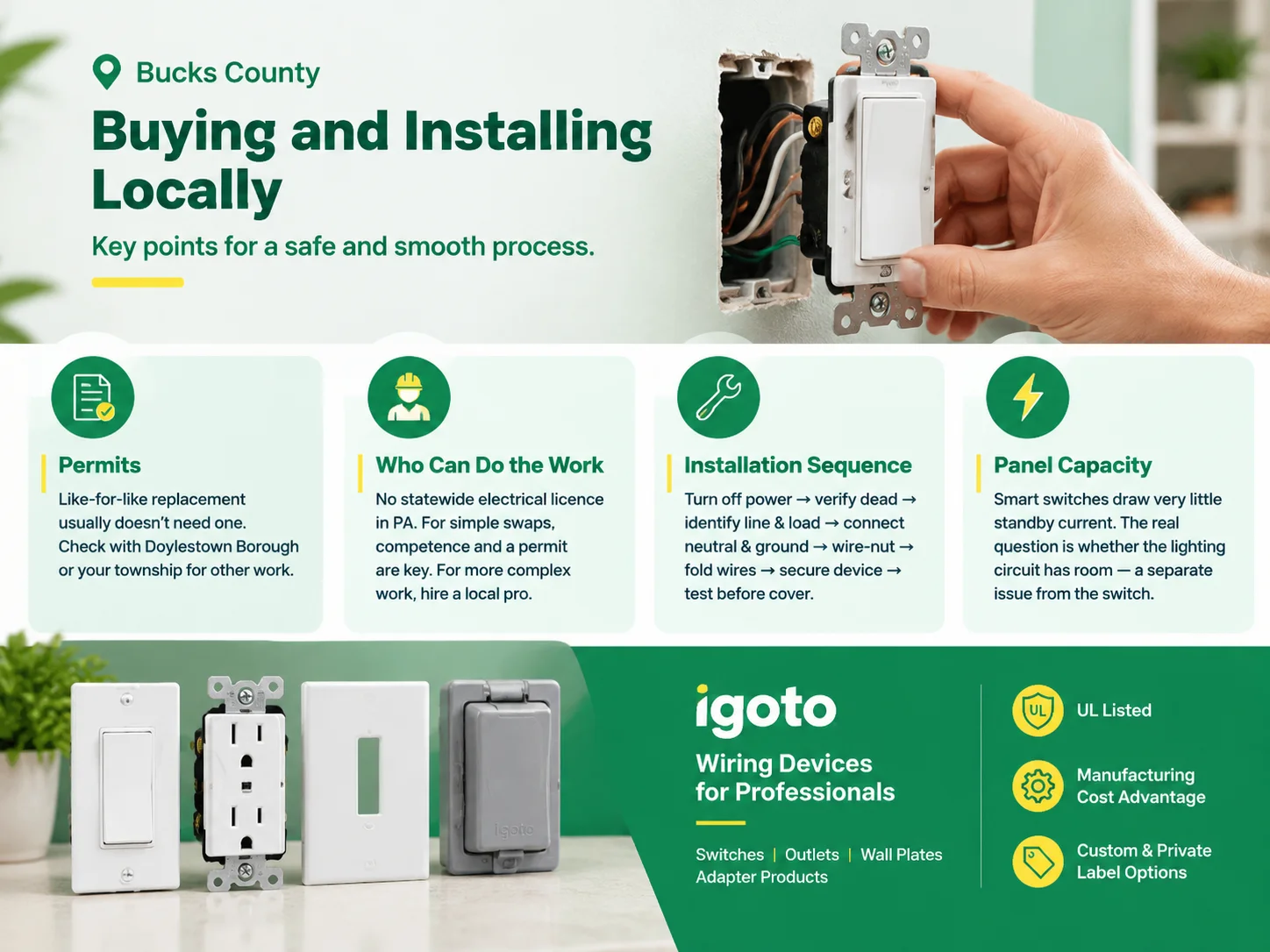
Important information concerning this idea in Bucks County.
Permits. Generally, replacing a device does not require a permit. It could need one if new cables, new circuits, new boxes in different locations, or work on the panel are required. Since the enforcement of permit requirements is municipal, check with Doylestown Borough or any township before you begin work instead of thinking that the easy rules of nearby boroughs will apply.
Who are the workers. Pennsylvania does not issue a state electrical license. It is regulated locally. The state is involved through the Bureau of Occupational and Industrial safety of the Department of Labor and Industry. If you are a homeowner who replaces a switch in his/her house, you need to be competent and get permits, as far as licenses are concerned. It is safer to hire somebody who has local qualifications for anything more serious than a simple replacement.
The procedure of installation. Turn the power off on the breaker. Use a non-contact tester to see if it is not working, define the line and load, connect neutral and ground wires, nut the connection, place wires back so that they do not get under stress, and fix the device ensuring that the plate is not fixed tightly. Make a test before replacing the cover. The procedures of installation are explained in the instruction of dimmer switch installation and mistakes to avoid while doing that, especially to avoid damages caused to the dimmer once the power is on.
It is necessary to mention where we stand in comparison with Lutron or Leviton.
Igoto is a manufacturer of wall switches and electrical outlets for OEM, contractors and distributors in addition to its other products. It does not sell a consumer smart home package. The products are available in North America in the form of ordinary and decorative switches, tamper-proof and weather-resistant outlet receptacles, as well as wall plates and adapters and comply with UL standards. We do not produce smart home controllers, apps or software for smart home management or installation.
This limits our field of action to two areas. If one is a dealer or contractor buying large numbers of electrical products, we have the advantage of lower cost of production which allows us to manufacture specifically for the client or under private label. If one needs to have a matching wall plate or the main switch along with the smart products keeping in mind the design, we can help to resolve the issue of matching the design.The programme scope is set out on the wall switch and power outlet manufacturing page.
Most buildings have it because, in addition to needing the internal radio and control unit, there should also be a continued return route without a constant dependency on the light being on.. Homes constructed after 1985 in most cases do feature an additional wire in the switch box, with a junction of white wires brought under wire-nut connections. But in older buildings, especially those in Doylestown, it rarely happens. The best known no-neutral device is Lutron Caséta, which draws a small current from the load whereas some particular models of other manufacturers also have that functionality. Don’t forget to look for the no-neutral capability on the box when you purchase the product.
The cost of the gadget is between $16 and $30 for a basic Wi-Fi switch, $35 and $50 for an intermediate dimmer priced at about $74–$100 for the Caséta available with its hub. Professional installation for each switch in the above-mentioned area will cost anywhere from $100 to $200, and the cost of installation of a three-way circuit or no-neutral retrofits is likely to be higher. If you receive an estimate that exceeds the above range for a simple single pole replacement, it is a good idea to ask what other things are covered in the price. In case the estimate is lower than expected, find out whether the contractor has an insurance cover and if the job can be carried out without a permit.
Generally, yes if reliability comes first, and generally, no if the budget comes first. Caséta is about three times more expensive than a budget WI-Fi switch + it needs a hub, but because it relies on a separate RF (radio frequency) signal, it does not need a neutral wire, and it is highly unlikely to go offline. In an older house with thick walls like many houses in Doylestown Borough, that reliability is worth more than the price difference. On the other hand, in a modern and well-Wi-Fi covered house, a $20 switch will do the job just as well.
It can be done by yourself for a single-pole replacement: turn off the circuit breaker, double-check that it is dead in the panel, find the line, load, neutral, and ground wiring, connect everything up, and check it before putting the cover back on, which should take approximately 20-30 minutes if this is your first experience. If you are working with three-way switches, no-neutral retrofits, aluminum wiring, or a box that does not allow you to install the device, then it is advisable to call an electrician for help. First verify the permit requirements in your area for the work.
Due to the use of various radio protocols. A Wi-Fi switch connects with the router and does not require a hub, but it competes for bandwidth over a 2.4 GHz connection. Zigbee, Z-Wave, and Lutron’s Clear Connect technology involve the use of a different radio band that is less reliable and uses less power, but it requires a hub in order to connect to a network or access the internet. Matter has made it easier to connect devices without the need for a manufacturer’s specific hub, however, the amount of features available still differs from brand to brand.
In most areas of Pennsylvania, a like-for-like device replacement does not need a permit. On the contrary, work that involves adding a circuit, installing new wiring, relocating a junction box, or changing the service panel does need a permit. Because enforcement is carried out at the municipal level, more than 90% of municipalities in Pennsylvania have their own programs. Always check with the Doylestown Borough or your township before beginning your project. Electrical permit costs in Pennsylvania range from $50 to $300.
Acquiring a smart switch in Doylestown comes down to three important considerations, namely whether or not there is a neutral wire in the box, whether the installation is of single pole type or of a three-way type, and whether the light bulbs being utilized are compatible with dimmable switches.
The list of possible smart switches available locally is fairly small. Lutron Caséta is the manufacturer of choice, being a Pennsylvania-based company, and thus quite easy to find and get support from too. Leviton Decora Smart is a good choice for those who have their homes set up with Apple technology, whereas Kasa and Tapo offer the budget alternative products for just about a fifth of the Lutron cost. Regardless of which one of these products gets chosen, budget anywhere from $16 to $100 for the product itself, plus another $100 to $200 for the installation, if you choose to hire someone to do the work.
Start with a single switch in your most used room, and then it will become clear whether your wiring will support smart switches accordingly!
The housing types available in Doylestown date back to the 1800s, and this is also the main challenge you face when trying to buy a smart switch here. What you can use comes down to what is inside your wall box and not which brand you can trust the most. The guide shows you which […]
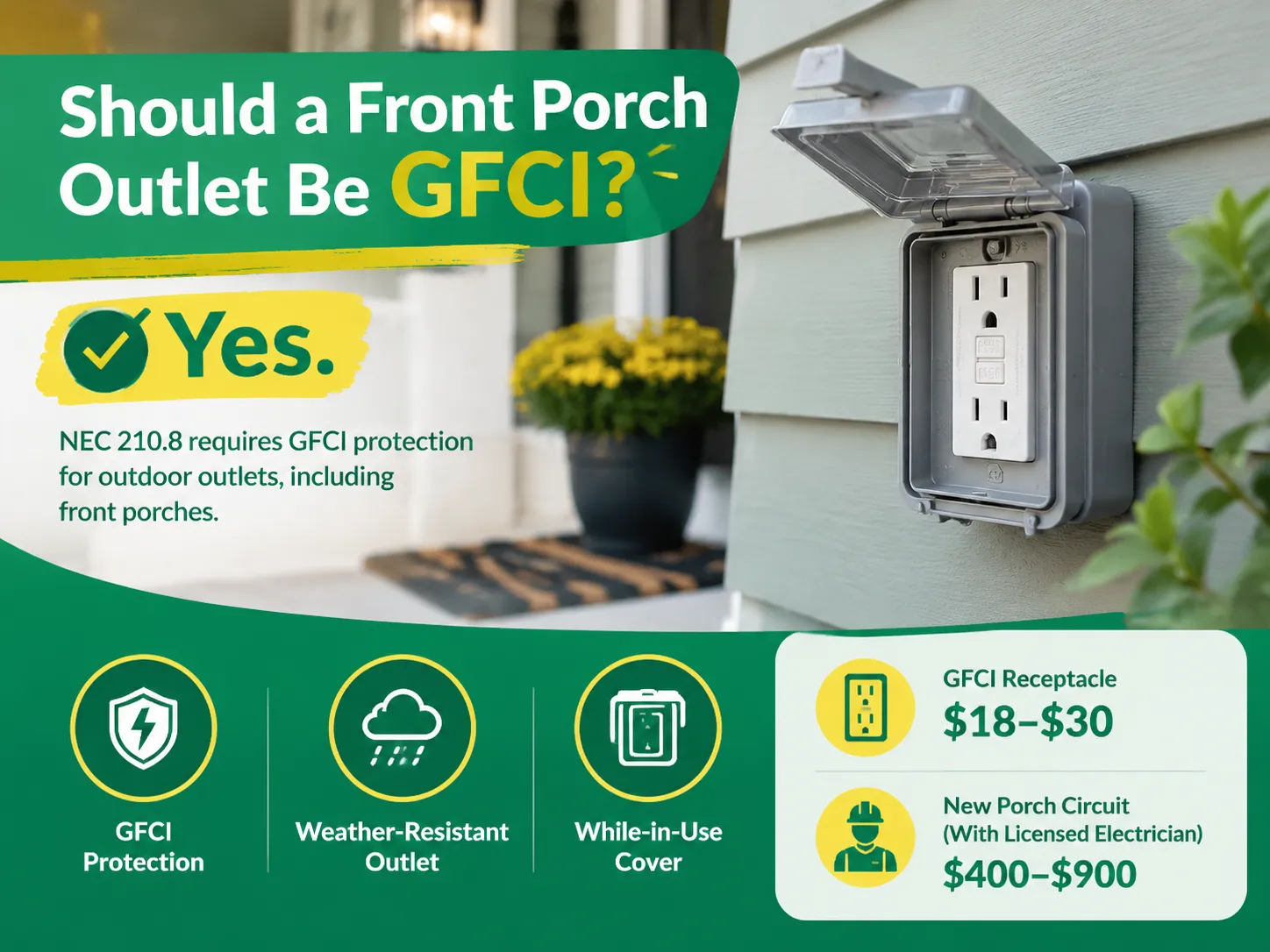
Of the very few areas of a house where the electrical code is crystal clear, the outlet located on the front porch is one such example. Since this area is outside, wet, and generally accessed through the doorway of the house, these elements trigger various requirements that have become quite stringent in the last two […]
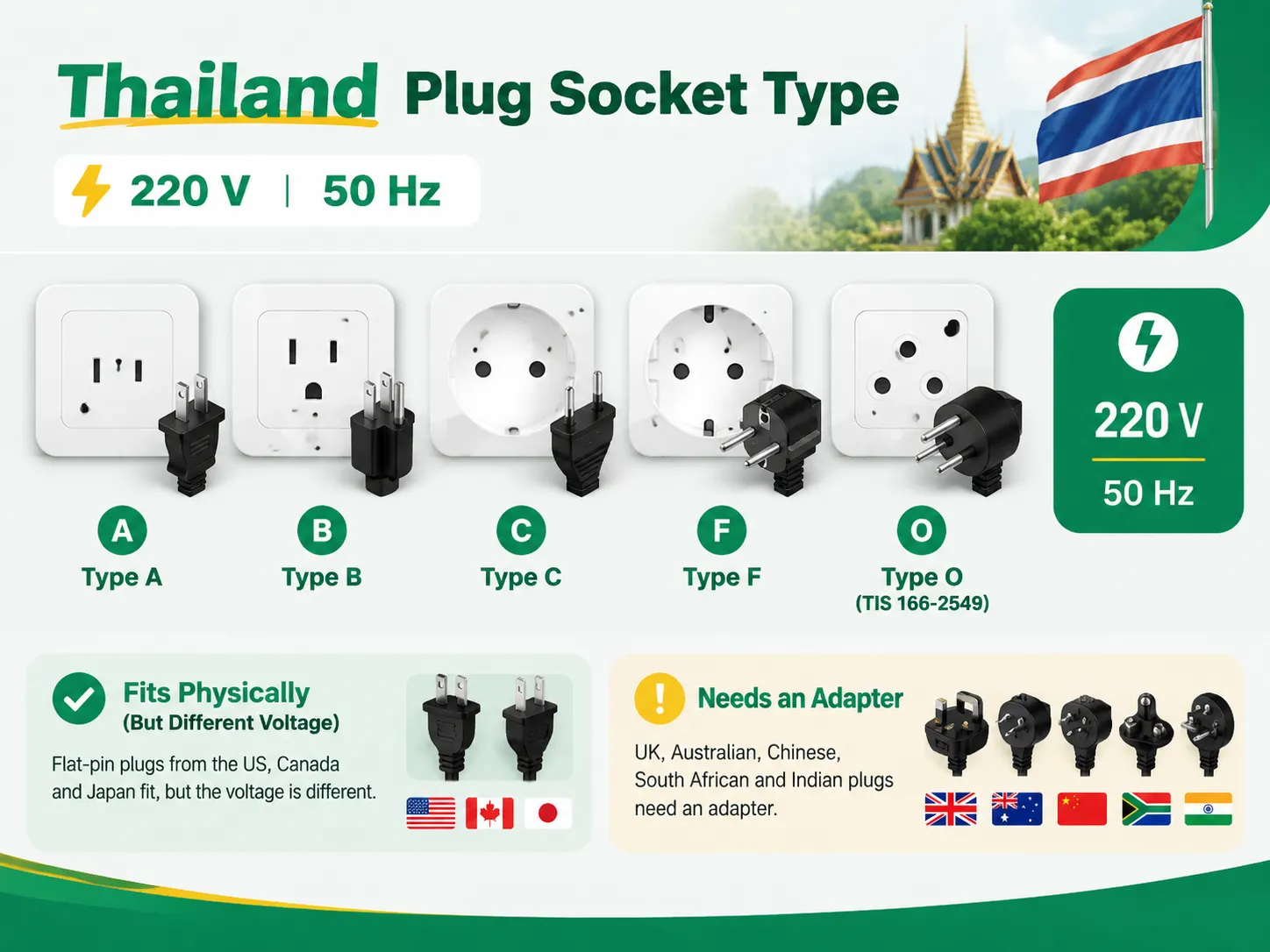
When traveling in Thailand, one of the things that makes Thailand easy for electronics users is that it has multiple types of sockets, but this is also one drawback in that the right plug does not necessarily mean an electrically safe plug. Here is how the sockets in Thailand look and what you will need […]

 No.6 Tuozhan Road, Leshang Pioneer Park,Yueqingwan Bay Harbor,Yueqing city,Zhejiang Province


